
Why Open Ended Materials Spark Creativity and Learning in Children
A child picks up a wooden block. One minute it is a phone. Then it becomes a bridge for toy animals. A few minutes later, it is part of a tower that keeps falling down, getting rebuilt, and changing shape each time.
That simple block is doing more than keeping a child busy. It is inviting thought, movement, language, planning, problem-solving, and imagination.
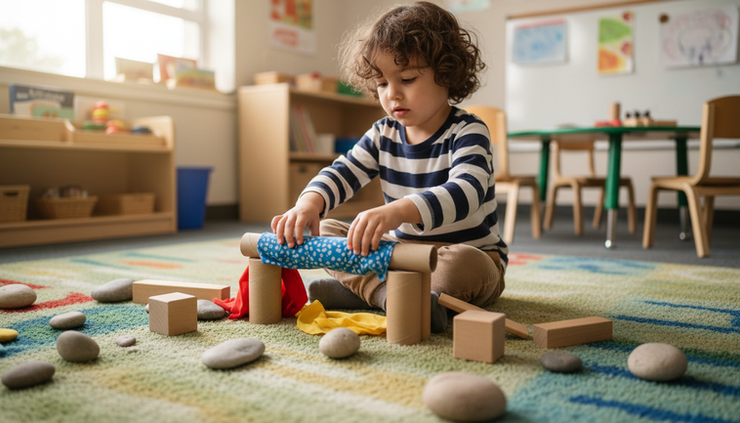
Open-ended materials are powerful because they do not tell children what to do. They leave space for children to decide. There is no single right answer, no fixed script, and no expected final product. A cardboard tube can become a telescope, a tunnel, a megaphone, or a rolling ramp. A scarf can be a river, a blanket, a cape, or a basket cover.
For toddlers and preschoolers, that freedom matters. Young children learn best when they can touch, test, repeat, change, and wonder. Materials with many possible uses give them a safe way to do all of that.
What open ended materials are
Open-ended materials are objects children can use in many ways. They are sometimes called loose parts, a term often used in early childhood settings to describe movable items that children can combine, redesign, line up, stack, sort, carry, fill, empty, or pretend with.
These materials can be natural, recycled, purchased, or homemade. What makes them valuable is not their cost. It is their flexibility.
Common examples include:
Wooden blocks
Cardboard boxes and tubes
Fabric squares and scarves
Pinecones, sticks, shells, and stones
Bottle caps and lids
Baskets, bowls, and scoops
Paper, tape, and string
Clay or play dough
Ramps, planks, and crates
Toy animals, figures, or simple vehicles
A closed-ended toy usually has one main purpose. A puzzle fits together one way. A shape sorter has a correct hole for each piece. These are useful too, especially for matching, fine motor practice, and persistence.
Open-ended materials work differently. They invite children to create the purpose. The child asks, often without saying it out loud, “What could this be?” That question is the beginning of discovery.
Why open ended play builds flexible thinking
Flexible thinking grows when children see that one object, problem, or idea can have more than one possible outcome. This is a major part of creativity. It is also a major part of real-life problem-solving.
A stick is a good example. In a child’s hands, it might become:
A spoon for stirring mud
A balance beam for a bug
A fence for a small animal world
A tool for drawing in sand
A measuring stick for comparing leaves
A pretend fishing pole
The stick has not changed. The child’s thinking has.
This kind of play helps children practice mental flexibility. They shift ideas, try new roles, and adapt when their first plan does not work. A tower tips over. The child tries a wider base. A cardboard ramp is too steep. The child lowers it. A blanket fort collapses. The child adds chairs, clips, or heavier objects to hold it in place.
These small moments matter. Children are learning to plan, test, observe, adjust, and try again. Those are the same habits that support later skills in science, engineering, art, writing, and design.
When a material has no fixed outcome, the child becomes the planner, the tester, and the storyteller.
The learning is in the process
Adults often look for the product. What did the child make? Is the tower tall? Does the drawing look like something? Did the bridge work?
Children, especially young children, often care more about the process. They are learning through repeated action. They stack and knock down. Fill and dump. Wrap and unwrap. Line up and scatter. Mix and separate.
That repetition is not random. It is how children study the world.
A toddler dropping stones into a metal bowl is exploring sound, weight, grip, and cause and effect. A preschooler arranging bottle caps by color is working with classification and pattern. A child taping paper tubes together is learning about structure, balance, and persistence.
Open-ended materials support this process because they allow children to return to the same object with new questions. The material does not get “finished.” It stays available for the next idea.

How these materials support brain development
Young children’s brains grow through active experience. They build connections as they move, talk, listen, explore, and solve problems. Repeated practice helps strengthen neural pathways related to planning, attention, language, memory, and self-control.
Open-ended play gives the brain rich practice because it combines many skills at once.
A child building a block ramp may be working on:
Spatial awareness
Hand-eye coordination
Early physics concepts
Prediction
Trial and error
Emotional regulation
Language and storytelling
Cooperation with peers
This is one reason meaningful play can look messy from the outside. A group of preschoolers may seem to be moving blocks, arguing over scarves, and changing the plan every minute. Underneath that activity, they are making decisions, solving social problems, and testing ideas.
The brain benefits from that complexity. One material can create many layers of learning because the child decides how to use it.
Creativity grows when children make the rules
Creativity is not limited to art projects. It shows up when a child finds a new way to carry pinecones across the yard, builds a pretend store from empty boxes, or uses blocks to make a zoo for toy animals.
Children develop creativity when they have chances to make choices. They need time to wonder, combine, change, and invent. If every material has a fixed use, children spend more time following directions than forming ideas.
Open-ended play gives children ownership. A scarf does not announce what it is. The child decides. That decision builds confidence.
This kind of play also supports symbolic thinking, which is central to early learning. When a block becomes a phone, the child understands that one thing can stand for another. That same mental skill later supports reading, writing, math symbols, and pretend storytelling.
A letter is a mark that stands for a sound. A numeral is a symbol that stands for an amount. A map is a drawing that stands for a place. Long before children work with those formal symbols, they practice the idea through play.
Open ended materials encourage language and social skills
When children create with flexible materials, they often need to explain their thinking. This leads to rich language.
A child might say:
“This is the door.”
“The animals sleep here.”
“We need a longer piece.”
“Don’t move that. It will fall.”
“Let’s make this part the river.”
These sentences carry planning, negotiation, sequencing, and vocabulary. Children describe size, shape, position, purpose, and relationships. Words like under, beside, heavier, taller, curved, full, empty, and balanced become useful because they connect to real action.
Open-ended materials also support social learning. Since the play does not come with a fixed script, children must work out roles and rules. They decide who builds, who gathers materials, where the road goes, and what happens next in the story.
That can lead to conflict, which is not always a bad thing. With adult support, conflict becomes practice in listening, waiting, explaining, and compromise.

The adult role is to prepare and observe
Adults do not need to teach every moment for learning to happen. With open-ended play, the adult role often begins with setting up the environment.
A thoughtful setup might include:
Materials children can reach independently
Enough pieces for more than one child
Containers that make sorting and cleanup simple
A mix of sizes, textures, and weights
Clear safety choices based on age and development
Time for children to stay with their ideas
Observation comes next. Watch what children do before stepping in. A child who appears stuck may be thinking. A group that is silent may be deeply focused. A repeated action may be an experiment.
When adults do join, questions can extend thinking without taking over.
Helpful prompts include:
“What are you working on?”
“What do you think will happen if you add this piece?”
“How could you make it stronger?”
“What else could that be?”
“What do you need next?”
The goal is not to lead children toward an adult answer. The goal is to help them notice, reflect, and keep thinking.
Simple ways to offer open ended materials at home or school
A rich play environment does not need to be expensive. Many of the best materials are already available in homes, classrooms, and outdoor spaces.
Start with a small collection and rotate it over time. Too many materials at once can overwhelm children. A few well-chosen items often lead to deeper play.
Try setting out:
Blocks, fabric, and animal figures
Cardboard tubes, tape, and small balls
Bowls, scoops, and dried pasta
Sticks, stones, leaves, and pinecones
Boxes, markers, and recycled containers
Children can build habitats, roads, beds, caves, or bridges.
Children can explore ramps, tunnels, rolling, and speed.
Children can fill, pour, sort, count, and pretend cook.
Children can make patterns, small worlds, trails, and nature art.
Children can create stores, vehicles, houses, or inventions.
For toddlers, choose larger materials that do not pose choking risks. Offer sturdy baskets, fabric pieces, large blocks, cups, and containers. Expect dumping, carrying, hiding, and filling. These are valuable forms of play.
For preschoolers, add more complex options such as tape, string, clothespins, ramps, recycled boxes, and natural items. Give them room to combine materials. Preschoolers often enjoy building scenes, creating stories, and returning to a project over several days.
Safety and boundaries still matter
Open-ended does not mean anything goes. Children need freedom inside safe, clear limits.
Adults should check materials for sharp edges, splinters, peeling paint, choking hazards, and items that can break into unsafe pieces. Supervision matters, especially with toddlers and mixed-age groups.
Clear boundaries help children use materials well. For example:
Sticks stay low and away from faces.
Small items stay at the table.
Blocks are for building, not throwing.
Materials return to baskets when play is done.
Water or sensory materials stay in the play area.
Boundaries should protect children without shrinking the play. A rule like “Sticks are only for looking at” removes the possibility of exploration. A rule like “Sticks stay below your shoulders” gives children a safer way to keep using the material.
Why this kind of play prepares children for later learning
The skills children practice with open-ended materials do not stay in the block area or the backyard. They carry into later learning.
A child who builds a bridge and changes the design after it falls is practicing the basics of engineering. A child who sorts stones by size, then color, then texture is building early math thinking. A child who turns a box into a spaceship is developing storytelling, planning, and symbolic thought.
These moments also build persistence. Children learn that the first attempt is not always the final answer. They begin to see mistakes as information. The tower fell because the base was narrow. The ramp did not work because the tube rolled away. The pretend house needed a door.
That mindset supports learning across subjects. Reading, writing, math, science, and art all require children to try, revise, and keep going.

A small shift that changes play
The next time a child reaches for a box, a block, a cloth, or a stick, pause before offering a plan. Give the idea room to grow.
Ask less. Watch more. Leave time for the child to repeat, revise, and surprise you.
Open-ended materials spark creativity and learning because they trust children to think. They invite children to explore what something is, what it could become, and what might happen next. In that space, play becomes more than an activity. It becomes the work of building flexible, curious, capable minds.
Be the first to read our newest insights.
Subscribe and receive alerts whenever a new blog post is published.


Comments